
ASVAB Score Range & Requirements for Military Enlistment
The Armed Services Vocational Aptitude Battery (ASVAB) is an important test for individuals interested in a military career or those exploring different civilian career paths. It helps evaluate an individual’s strengths, skills, and abilities. These insights help individuals better understand their potential. Knowing your ASVAB score range is important because it can help you select a career that matches your skills and interests. We will guide you on how the ASVAB scores are calculated, interpreted, and used for career exploration and military enlistment.
What Is ASVAB Scoring System?
ASVAB score ranges are reported with 1 to 99 and are presented in percentiles. A percentile essentially describes how well you did compared to everyone else who took the test. The higher the percentile, the better you did compared to other students in your grade.
For example, a score of 90 is better than 90% of the people who took the test, while a score of 50 is better than just half of the test takers. The ASVAB passing score varies depending on the branch of the military you’re applying to. Generally, the minimum ASVAB score required for enlistment is:
- Army: 31
- Navy: 35
- Air Force: 36
- Marine Corps: 32
- Coast Guard: 40
As for the highest ASVAB score, there is no fixed “highest” score, as the ASVAB is scored on a standardized scale. However, the highest possible score you can achieve on any subtest is 99.
Types of Scores on ASVAB
Here are 3 major score types on the ASVAB exam that provide insight into your skills.
1. Career Exploration Scores
These scores help you see different career choices based on your scores. They provide valuable insights into areas where you may excel and suggest paths that align with your strengths and interests.
2. ASVAB Subtest Scores
The ASVAB contains 8 subtests that emphasise different areas, including math, verbal, and mechanical skills. The score indicates your strengths and weaknesses in the outlined areas.
3. AFQT Scores
The Armed Forces Qualification Test (AFQT) score is calculated based on 4 subtests of the ASVAB, which are: Arithmetic Reasoning, Mathematics Knowledge, Paragraph Comprehension, and Word Knowledge. The score you get is a determinant of whether you are recruited into the army or not.
Interpreting Your Career Exploration Scores
Your Career Exploration Scores evaluate your skills in critical areas to help you better identify your areas of strength. These scores guide you to possible career paths by highlighting your areas of strength. Career Exploration Scores are broken down into three categories:
Verbal
This score evaluates your comprehension of what you have read, vocabulary, and ability to reason. Those who have scored high in this category demonstrate good verbal skills and are likely to do well in writing, teaching, or even practising law.
Math
This score evaluates your problem-solving skills in basic arithmetic and algebra. Those who have strong scores here have the chance to work in high-paying positions in engineering, finance, or even technology.
Science/Technical
This score evaluates your ability to understand and work with scientific concepts. Those who score high here are likely to do well in research, technology, or even medicine.
How Are the ASVAB Subtests Structured?
There are eight ASVAB subtests, and all of them qualify the applicant’s abilities in varying areas. These subtests show the applicant’s level in each area and what possible job roles they can apply to, as well as what areas they may want to improve in. ASVAB subtests consist of:
Arithmetic Reasoning
This subtest focuses on whether the applicant can appropriately answer and solve word problems. This also translates to the applicant’s ability to make and solve problems in real-life situations.
Mathematics Knowledge
This subtest also focuses on the applicant’s knowledge of fundamental principles of mathematics, which include Algebra as well as other branches of mathematics (Geometry).
Word Knowledge
This subtest focuses on the levels of understanding and the applicant’s ability to use terms in their correct contexts.
Paragraph Comprehension
This subtest evaluates the ability of the applicant to be able to read. It also understands what the paragraphs are about and can make reasonable conclusions from what they have read.
General Science
This focuses on the knowledge that the applicant has in the field of science. It may include even the basic subject areas such as Biology, Chemistry, Physics, and Earth Science.
Mechanical Comprehension
This subtest evaluates the applicant’s ability to understand the basic mechanical functions and the principles of mechanics. They are important for all technical jobs.
Electronics Information
This evaluates the applicant’s understanding of the field of electronics and electronics systems. It is very important in the field of Electrical Engineering, Technology, and Electronics Maintenance.
Automotive and Shop Information
This subtest focuses on evaluating the knowledge of the applicant in the field of automotive mechanics and the practices of workshops. This is also important in the automotive field, as well as the related areas of the automotive industry.
How is the ASVAB Score Calculated?
You can calculate your ASVAB score manually or use an ASVAB score calculator available online. The most accurate method for calculating the ASVAB score is given below:
Step 1: Raw Scores
First, your raw score is calculated by counting how many questions you answered correctly in each subtest.
Step 2: Conversion to Standard Scores
These raw scores are then converted into standard scores based on statistical scaling. Each subtest score is scaled to a mean of 50 and a standard deviation of 10, helping to compare your performance with others.
Step 2: Composite Scores
The military uses specific composite scores for different job roles, which combine the relevant subtest scores.
Step 3: AFQT Score
This is a critical score used to determine overall eligibility for military service and is derived from your Verbal and Math subtest scores.
ASVAB Score Range Chart
The AFQT score is a critical component of the ASVAB. It determines your eligibility for military enlistment and plays a major role in the selection process. The AFQT score is derived from four subtests: Arithmetic Reasoning, Mathematics Knowledge, Paragraph Comprehension, and Word Knowledge. The ASVAB score chart is given below.
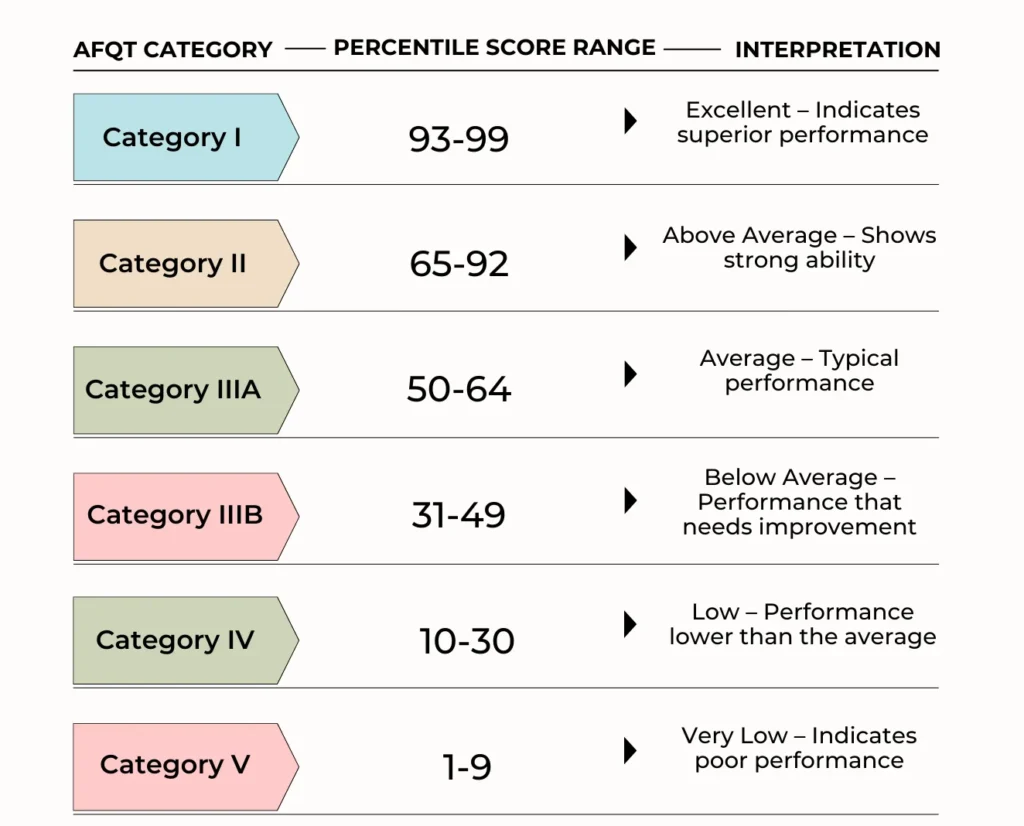
Standard Scores VS Percentile Scores
Standard Scores show what you did compared to others who took the test. Standard Scores are calculated using an average of all the test takers around the same age. If you score an average asvab score range of 50, then you did the same as everyone else and scored the same. If you score a 60, then you did better than 84% of people who took the same test as you.
Percentile Scores show what you did compared to others who took the same test as you. A percentile of 66 is equivalent to doing better than 66% of test takers. These scores are an estimation of what you did compared to others who took the test.
What is a Good ASVAB Score Range?
Depending on personal goals and ambitions, a good ASVAB score may mean something different. As an example, when scoring the AFQT section for military service, the higher the score, the better it is. Each military service branch has a requirement for an AFQT score, and scoring a 50 is generally seen as an acceptance score.
When looking for jobs in the future, having a score in the higher percentiles in particular areas like Math or Science is going to benefit you. While a good score is not a definite thing, scoring higher than average will definitely give you more opportunities for military service and exploring career options.
How To Improve Your ASVAB Score?
To improve an ASVAB score, you must first understand what personal weaknesses you need to improve on. The best way to improve is to study guides and practice questions. We suggest you concentrate on the areas that you find the most difficult first.
- Practice Tests: This will give you the best opportunity to become acquainted with the format and the types of questions you will be answering.
- Tutoring: Private instruction or study groups will give you the best opportunity to have designated time to focus on what you need to do to increase your score.
- Review: Go back to the areas that you had trouble with and work on improving those particular areas so that you can do better.
FAQs
How long is the ASVAB score good for?
ASVAB scores are good for two years. If you need the score for enrolling, you’ll have to take the test again after two years.
What jobs do I qualify for with my ASVAB score?
Your ASVAB score range helps determine which military jobs you can get. Higher scores give you more options for specialised roles like IT, mechanics, or electronics.
How many times can I take the ASVAB test?
You can take the ASVAB test three times. For the first test, you must wait one month for the second test. If you want to take the test a third time, you must wait six months. After that, you have to wait one year to take it a fourth time.
Can I apply for civilian jobs using ASVAB scores?
Yes, the ASVAB scores can help in career exploration for civilian and military jobs. For jobs that require a lot of calculations, many employers consider ASVAB scores when hiring.
Is a calculator allowed on the ASVAB?
No, you can’t use a calculator on the ASVAB. You have to do the work yourself. This is so the test can check your actual reasoning and problem-solving ability.
Conclusion
The ASVAB score range helps to guide you in the skill area you will need the most in the military enlistment process and in your career exploration. Knowing your ASVAB composite scores sheet helps you to find the areas in which you are weak and strong, so you are better able to make some solid choices in life. It helps you to zero in on what you want to do while also helping you find what you would do best.